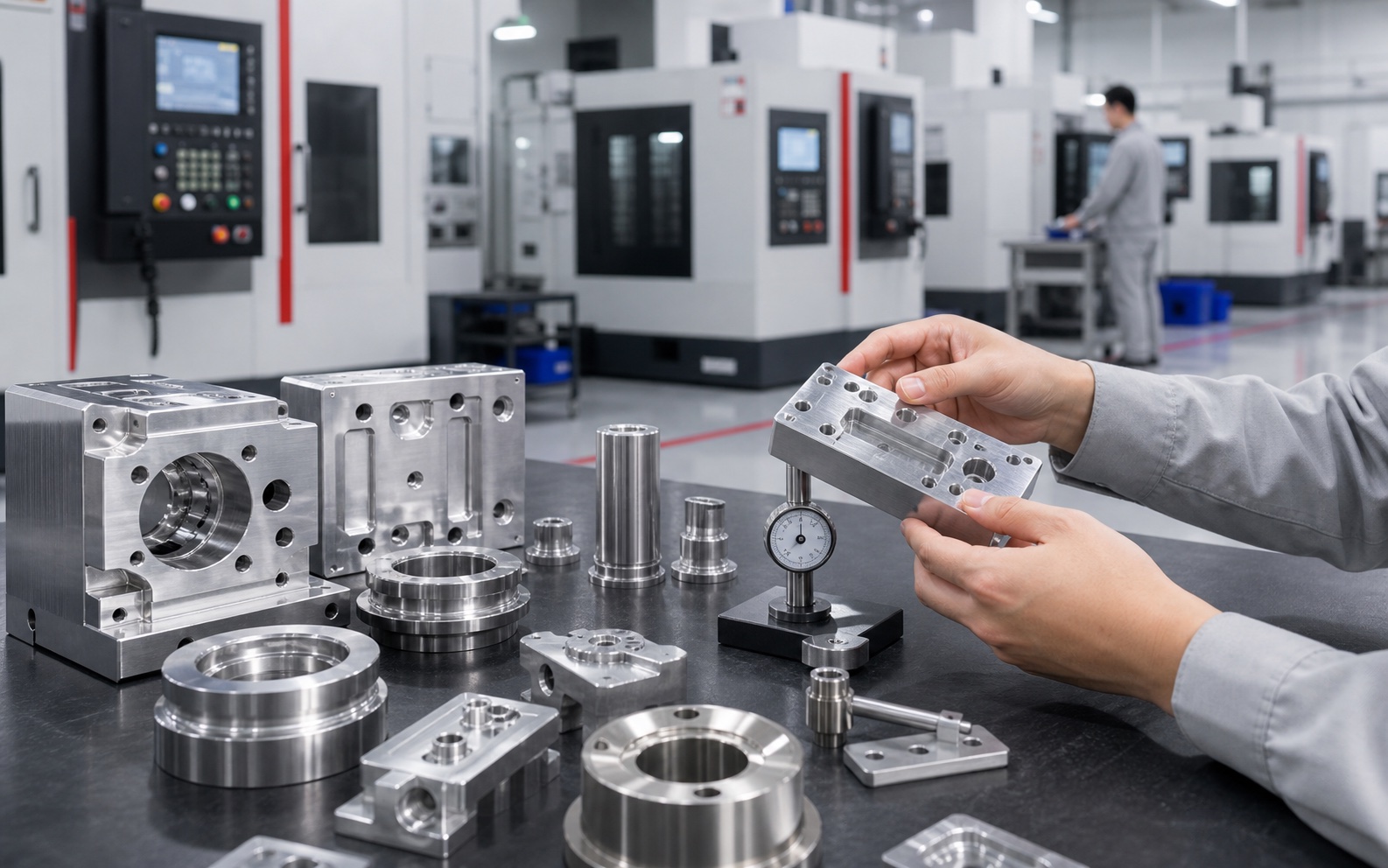
Buyers searching for CNC milling, CNC turning or precision parts need to know whether a part should be milled, turned, wire cut, EDM processed or supported by a fixture. The right process controls tolerance, surface quality and cost.
1. CNC milling suits plates, grooves, holes and fixture structures
CNC milling is commonly used for plates, blocks, pockets, slots, locating holes, assembly faces and fixture structures. For multi-face parts, setup planning controls concentricity, parallelism and repeatability.
2. CNC turning suits shafts, sleeves, pins and round parts
CNC turning is suitable for shafts, sleeves, pins, spacers and threads. If a part combines round geometry with milled faces or off-center holes, it may require turning, milling or mill-turn processing.
3. Aluminum, stainless steel and other metals need different controls
Aluminum machines well and is widely used for fixtures, housings, plates and lightweight parts, but surface quality after anodizing must be considered. Stainless steel and steel require stronger control of tooling, heat, deformation and dimensional stability.
4. Jigs, fixtures, molds, wire cutting and EDM belong in process planning
For narrow slots, difficult profiles, hard materials or mold details, wire cutting and EDM may be more effective than standard milling. For connector assembly or inspection projects, dedicated fixtures improve speed and reduce variation.
5. Quality inspection should follow functional dimensions
Not every dimension has the same importance. A factory should define critical dimensions, use calipers, height gauges, 2D inspection or suitable methods, and keep first-sample and repeat inspection records.