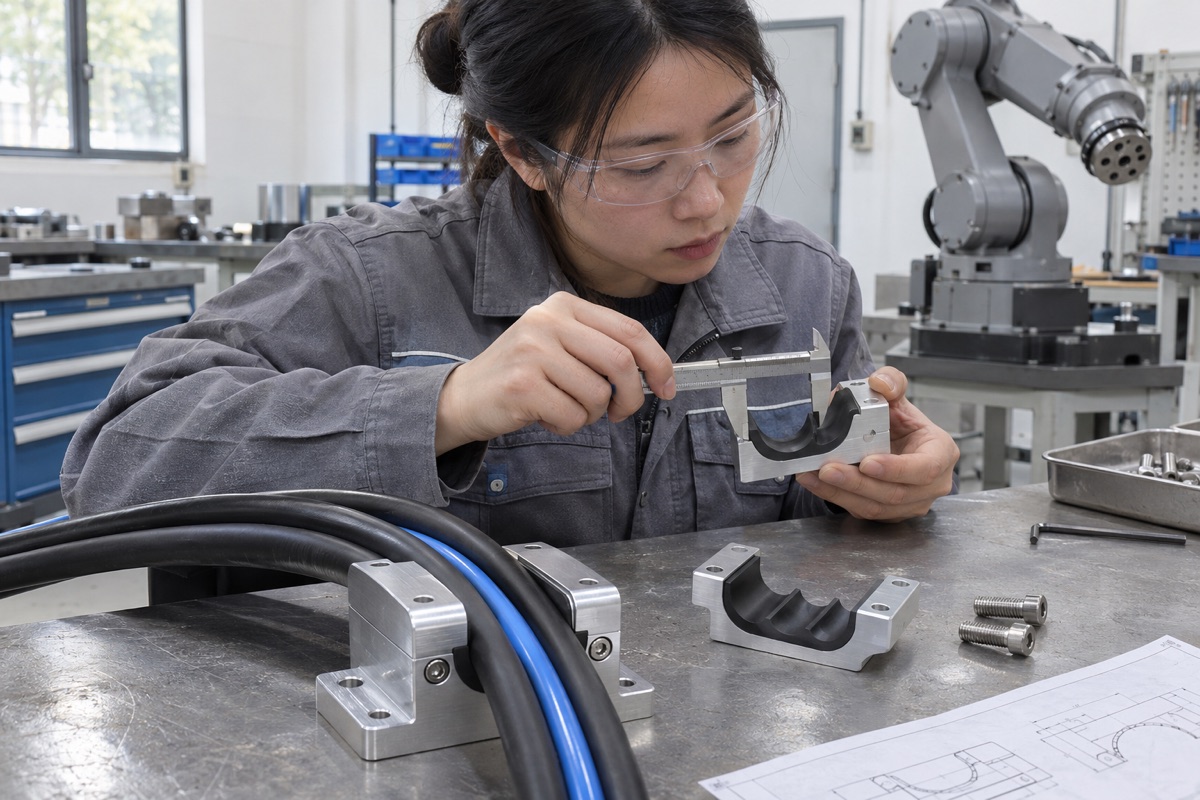
Repeatedly tightening a slipping cable clamp can turn movement into jacket damage. First decide what the part does: grip a jacket, mount a carrier, or guide the route. A dimensionally correct CNC clamp does not establish that the complete dress pack can safely follow every robot move.
Distinguish fixed anchors from sliding guides
Identify cable codes, diameter ranges, jacket materials, hoses and connector positions on the assembly drawing, with each clamp's function. Use the cable model's dynamic bend and torsion data; a static bending limit is not enough. The cable-system design must identify fixed points, guiding points and compensation sections. Not every support should immobilize the cable.
Let the body mount and the liner contact
A split aluminum body can attach to an equipment bracket while replaceable liners accommodate approved diameters and worn contact surfaces. Check any proposed POM, elastomer or other liner against temperature, oils, cleaners and compression behaviour. A soft feel alone does not prove jacket protection. Smooth contact edges and keep split lines, fastener heads and machining burrs from becoming pressure points.
Dimension the closed assembly, not only the groove
Specify mounting datums, hole spacing, contact profiles, closing gap, liner retention and permitted tightening conditions. Different cable and hose diameters under one cover can leave one loose while crushing another; design contact zones separately. First-article checks should include the closed shape, screw bottoming and contact distribution. Do not compensate for unsuitable geometry by applying more fastening force.
Verify the complete motion envelope
Perform installation checks under the site's energy-isolation procedure. Authorized integrators should validate motion under the robot manufacturer's procedure, including tool changes, homing and extreme poses. Observe bending, twisting, slack, collisions and connector loading, then inspect wear over an agreed cycle sample. Send Vietlink Precision interface drawings, cable data, the movement envelope and quantity for a machining review. System safety and cable life require system-level validation.