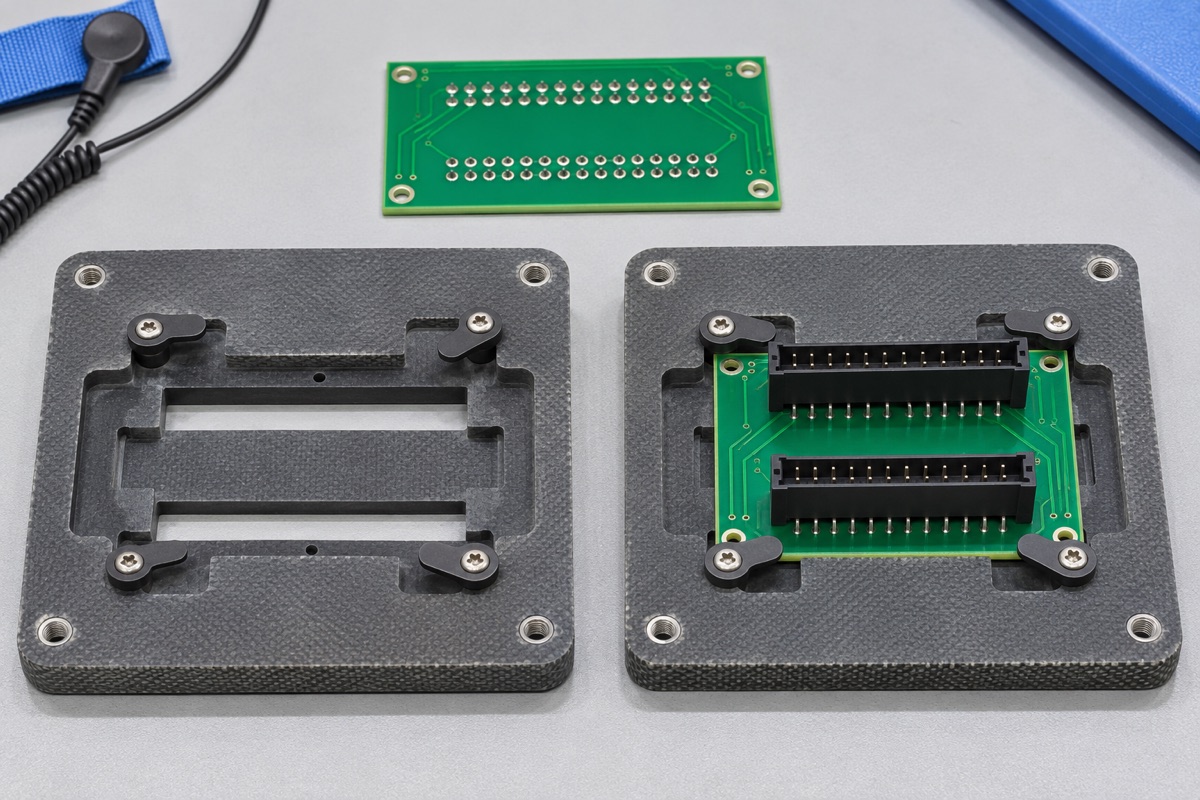
A mixed-technology PCB has connector leads that need solder and nearby components that must stay clear of the wave. A selective wave solder pallet separates these regions while supporting the board. Clamping harder will not solve every solder defect. A board that fits cold must also release properly and remain accessible to solder when hot.
Send both board faces and the process direction
Include outline, board-thickness tolerance, locating holes, underside component heights, through-hole solder areas and connector assembly details. Identify the revision and travel direction. Distinguish permitted support zones from keep-outs. If a long connector needs an upper hold-down, its contact must be on an approved housing support area, not on leads or fragile components.
A window is more than an enlarged pad outline
Window walls may obstruct solder flow while nearby relief pockets reduce remaining pallet thickness. Review travel direction, joint positions, underside component envelopes and structural support together. Narrow bridges, cutter-generated corners and thin edges affect CNC manufacturability. Removing every wall around the pins may expose the very surface-mounted components the pallet is meant to protect.
Specify the material grade against the process
Solder-pallet composites differ in heat, flux and electrical properties; black colour does not identify a suitable grade. Ask the material supplier to review peak temperature, exposure time, cleaning chemistry and ESD requirements. Where dissipation is needed, verify resistance in the specified condition and the complete grounding path. Metal fasteners alone do not establish the electrical performance of the assembly.
Inspect joints and pallet during the first process trial
Check cold location, flatness, clearances and loading first. Qualified process staff should then run an approved thermal trial, recording the profile and agreed joint criteria such as bridging, missed solder and hole fill. Also check binding, warpage and surface damage. Send Vietlink Precision the drawings, process conditions and acceptance list for a machining review; dimensional inspection does not replace solder-process qualification.