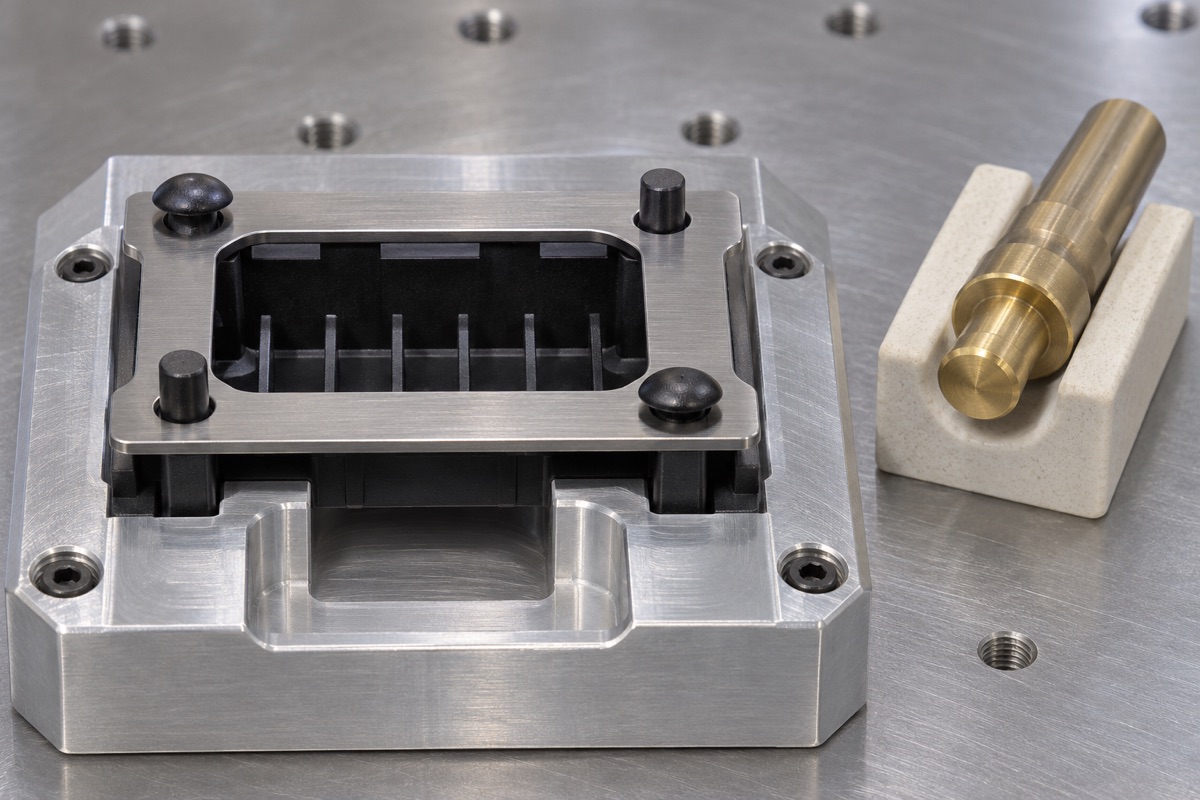
Four neat heads can still leave a metal retainer rocking after cooling. Adding more heat may only make the heads larger. For thermally formed plastic bosses, first check whether the plate sat on its intended seats and whether the boss roots moved with an unsupported housing under load.
Separate incoming-part variation from tooling
Compare unstaked boss height, retainer thickness and holes, underside burrs and any molded feature lifting the plate. Mark allowed support areas, cosmetic surfaces and contacts that must not carry load. Forcing a plate flat when the incoming stack will not seat transfers the mismatch into the finished joint.
Put reaction support near the bosses
Locate support along the load path rather than beneath a floating thin wall or terminal. Relieve sensitive central features without removing support under the boss roots. Choose an aluminum nest, steel wear supports or temperature-rated insulating pads for the actual thermal and equipment interfaces; an ordinary plastic pad is not automatically suitable.
Include cooling and removal in the trial
Check tool-to-boss alignment and plate seating. The process owner establishes heating, hold and cooling conditions for the selected resin and equipment. Record springback, tip adhesion and housing distortion after release. Flatness while a part remains clamped does not describe its free condition.
Replace a subjective loose-feel check
Agree head appearance, retainer gap, retention test direction and acceptance, then recheck the connector mating features. Measure in the specified cooled state. Set up thermal equipment under its protective procedures. Send Vietlink Precision housing and retainer samples, resin grade, boss drawing and machine interface for a replaceable nest and support review.