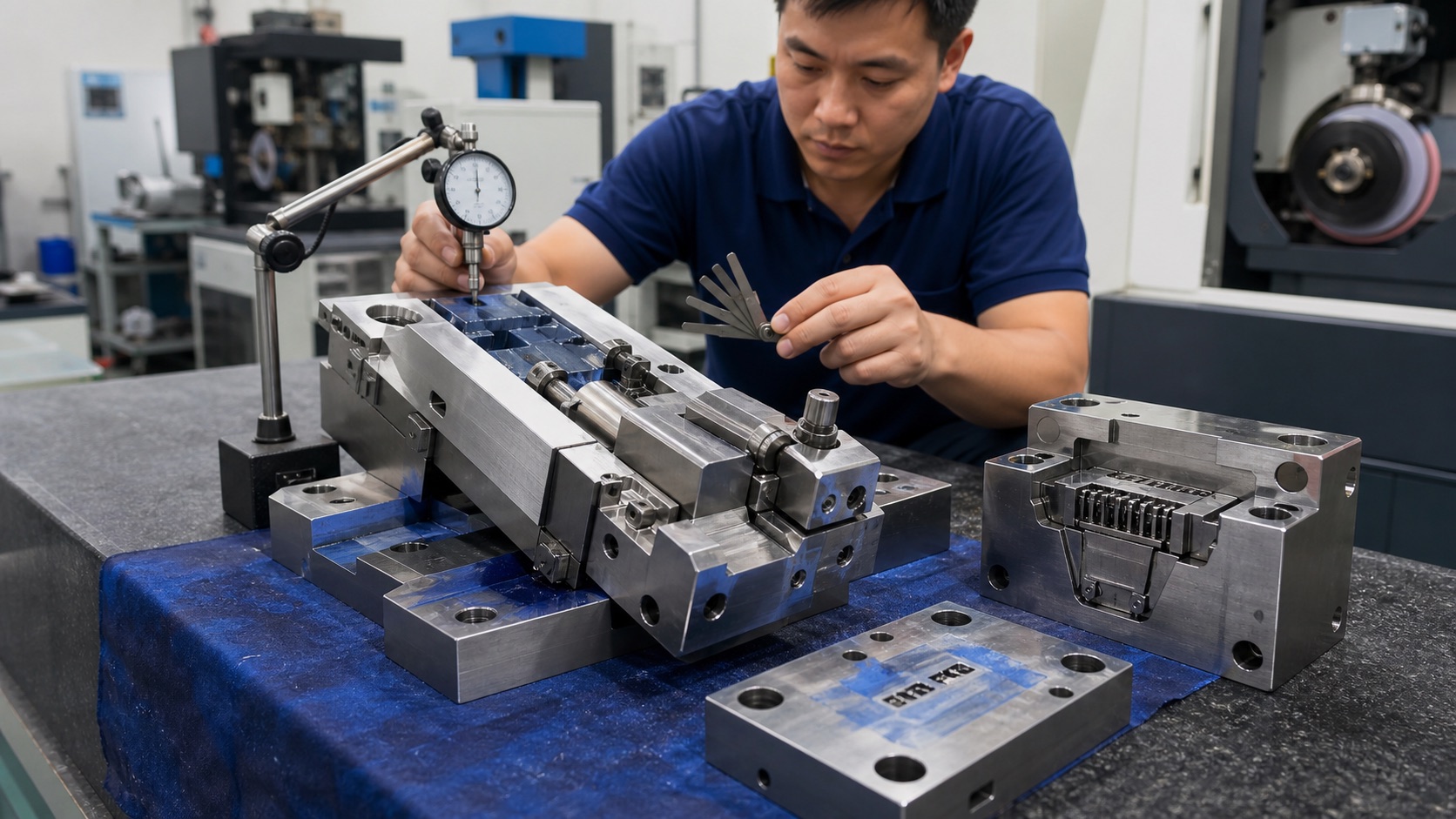
Small connector latches and undercuts often need a slide or lifter. Misaligned lead angles, clearance, bearing faces and lubrication can cause binding, flash or part deformation.
Separate molding surfaces from load-bearing surfaces
The forming tip controls latch geometry, while gibs, wear plates and locking faces carry mold load. Each zone needs its own material, hardness and fitting allowance.
Machine lead angle and travel for the mechanism
Cam angle, stroke, overtravel and product release must work through the full cycle. CNC establishes datums and tracks; EDM completes deep corners and restricted forms.
Spot contact while preserving functional clearance
Spotting verifies locking and sliding contact, while cavity clearance must allow motion without creating flash. Uncontrolled polishing can shift the forming position.
Set cleaning and wear-inspection intervals
Plastic debris, dust and poor lubrication increase friction. Monitoring scoring, play, springs, pins and wear plates by shot count supports replacement before product quality changes.