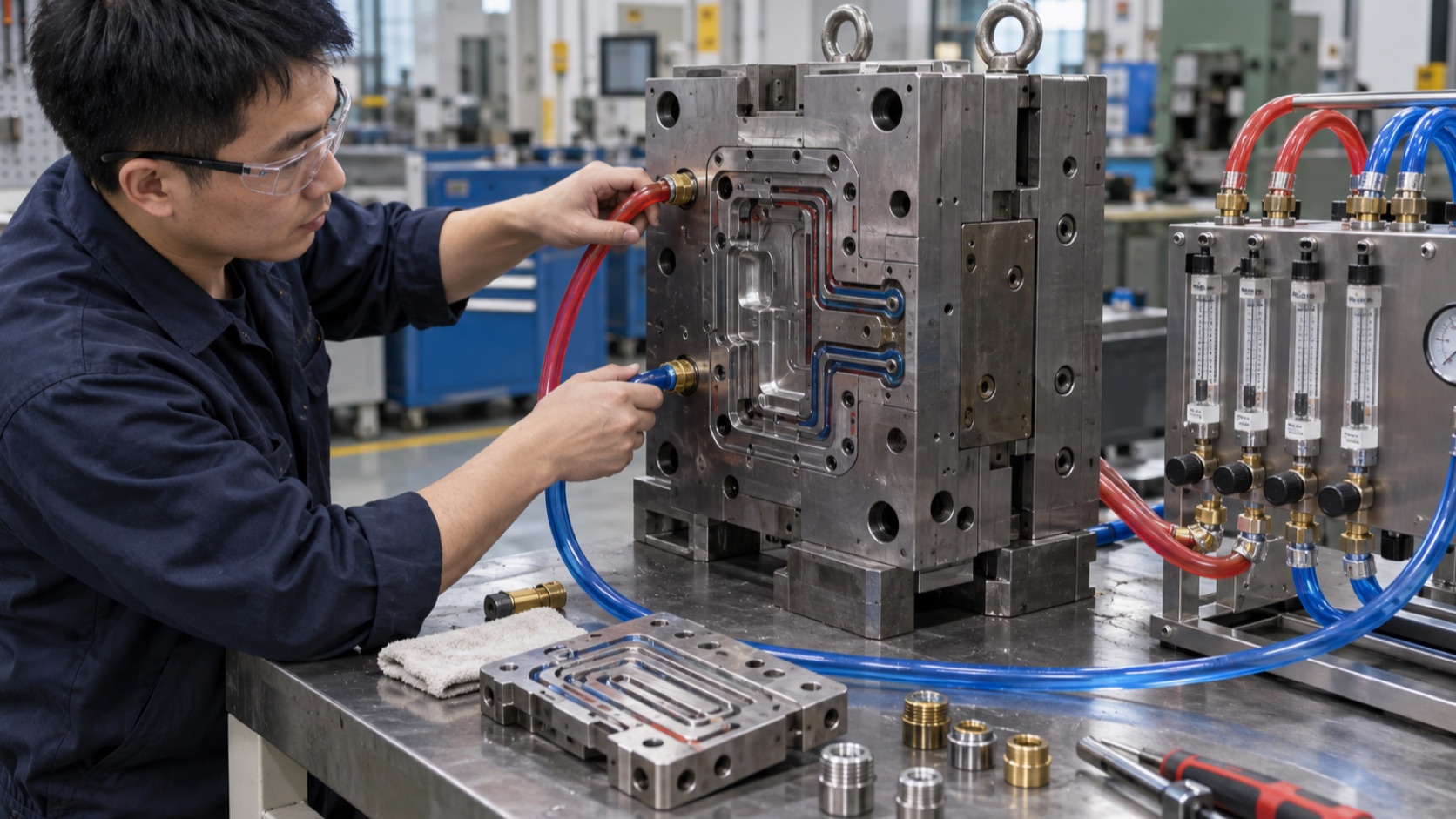
Two cooling circuits connected to the same supply do not necessarily cool equally. Different length, fittings, diameter, scale and baffle condition change resistance. For small connector cores, a weak branch may show up as local shrinkage, warpage, long cycle time or dimension drift after ejection.
Map each circuit and link it to the part symptom
Mark inlet, outlet, flow direction, core or cavity zone and connection size. Record water temperature, actual flow and pressure drop by circuit. Compare the map with hot spots, shrinkage, warpage and ejection timing so maintenance addresses the affected steel rather than changing molding settings blindly.
Check baffles, bubblers, plugs and restrictions
A baffle must divide the drilled passage and reach the intended depth without blocking the return path. Inspect orientation, looseness, corrosion, damaged seals, wrong plugs and scale. Parallel circuits may require individual flow control; connecting a high-resistance branch beside a short open path can starve the difficult area.
Create a repeatable acceptance and cleaning routine
After cleaning or repair, flush each circuit separately, leak-test at an approved pressure and record stable flow at a defined inlet condition. Use compatible water treatment and dry the tool for storage. Keep baseline values with the mold so declining flow is noticed before quality or cycle time changes.