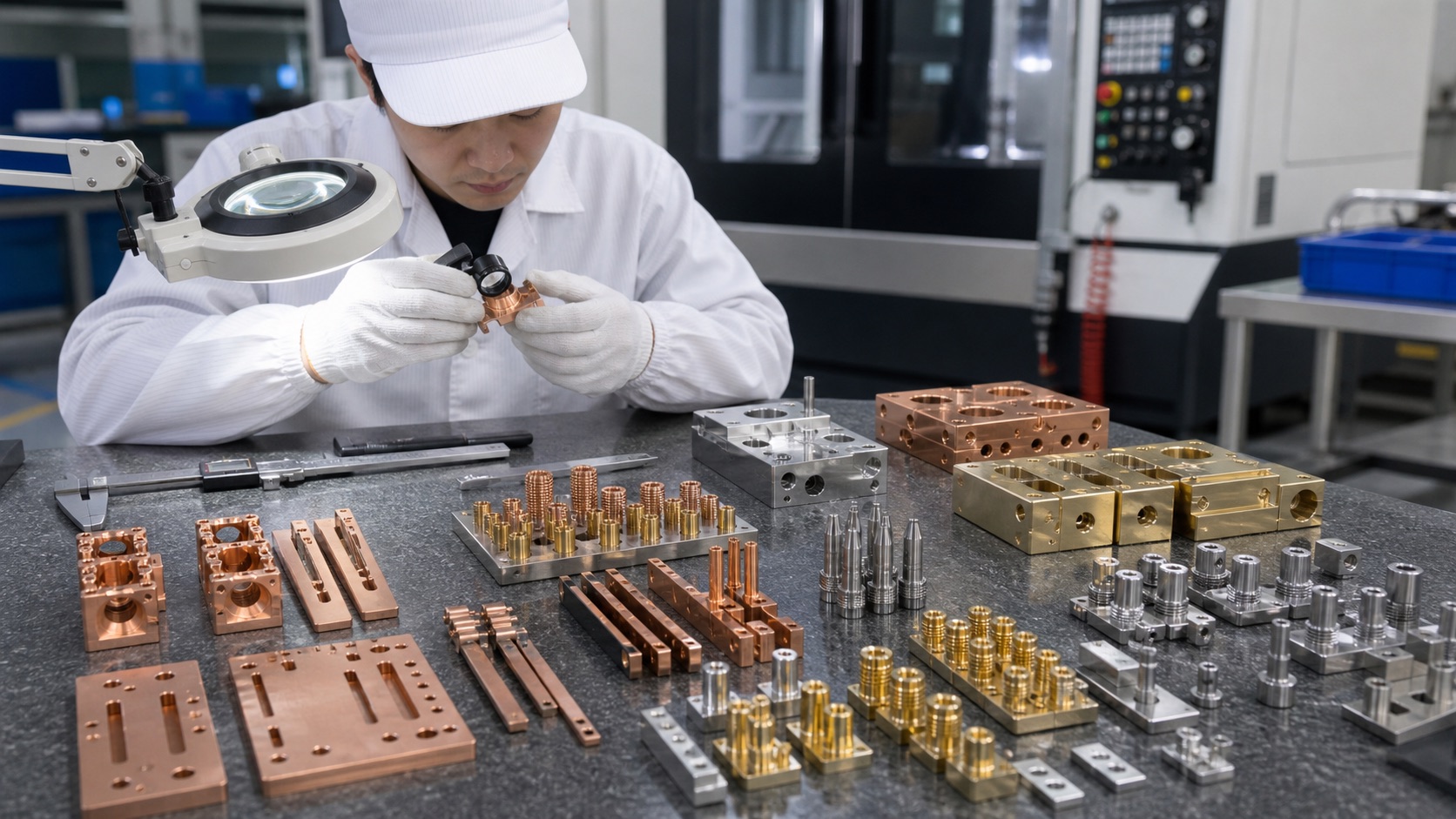
Copper and brass are useful for conductive parts, but burrs, clamping marks and contact surfaces must be managed carefully. Design choices should balance conductivity, assembly and machinability.
Choose material by function
Pure copper is better for conductivity and thermal transfer. Brass is easier to machine and often suitable for terminal blocks, spacers, threaded inserts and moderate contact parts. If plating is required, allowance and contact areas should be considered early.
Burr control is critical for connectors
Small holes, narrow grooves and contact edges can easily create burrs. In connector parts, burrs may block assembly or affect electrical contact. The drawing should mark which edges need deburring, which edges must stay sharp and which surfaces must avoid scratches.
Threads, holes and contact faces
Copper is softer than steel, so tapping, reaming and slot milling require suitable cutting force and clamping. For contact blocks, small busbar parts or BMS inspection fixtures, hole position, face flatness and surface cleanliness are important.
Information for a reliable quote
Send the exact material, conductivity requirement, surface finish, plating need, electrical contact areas, quantity and inspection standard. If an old sample exists, photos and measured dimensions help the supplier evaluate faster.