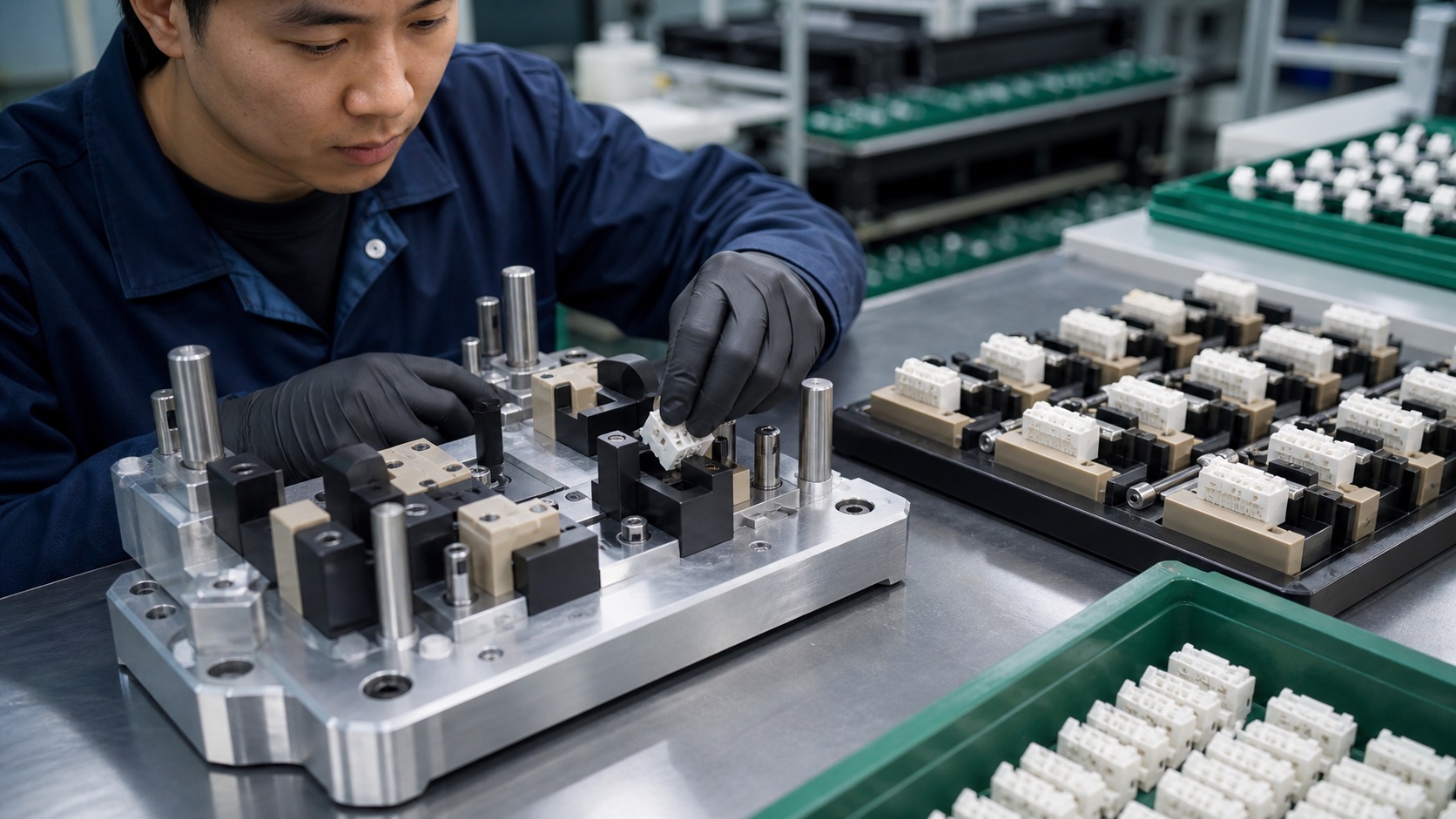
Metal nests can scratch or deform plastic connectors, while an all-plastic fixture may lack rigidity and wear quickly. A hybrid structure places each material where it provides the best balance of part protection and production life.
Use plastic at product contact areas
POM works well for many general-purpose nests because it has low friction and machines cleanly. PEEK is considered for heat, chemical exposure or higher dimensional stability, but at a higher material cost.
Use metal for the base and hard datums
Aluminum keeps the fixture light and machinable, while hardened steel pins resist repeated wear. Hard metal datums should be separated from surfaces that could mark the product.
Make wear inserts replaceable
Contact and wear areas should be small removable modules. When a connector model changes, the nest or insert can be updated without remaking the entire fixture.
Validate with real loading cycles
Test the fixture with actual products through repeated loading and removal. Check for scratches, looseness, clamp force and access for either an operator or robot.