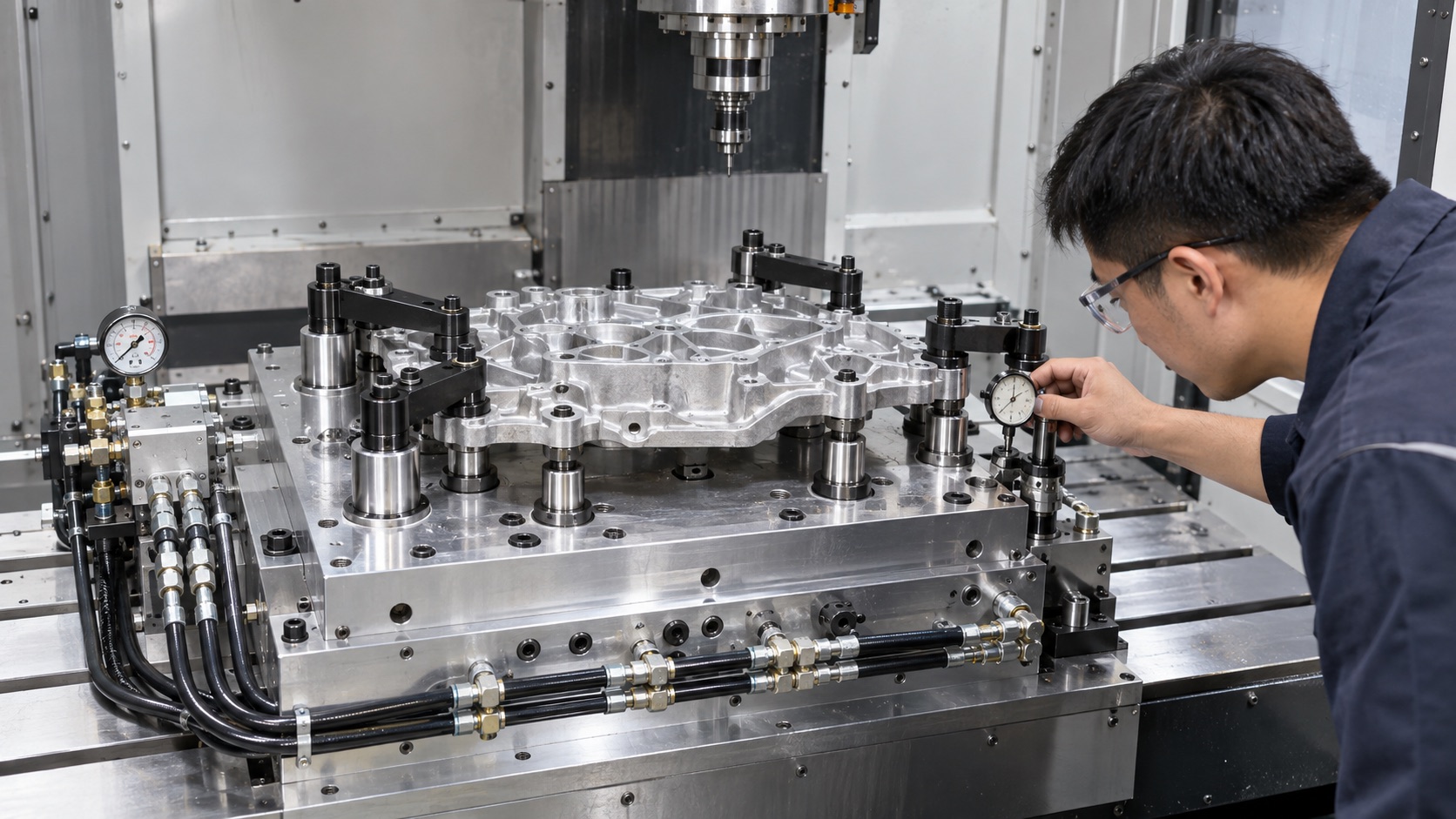
Hydraulic workholding provides repeatable force only when pressure reaches each actuator and the fixture directs that force into stable locators. A pressure gauge at the power unit cannot prove that every clamp and support has seated correctly. Troubleshooting should separate locating error, hydraulic loss, sequence error and workpiece deformation.
Make locators carry the cutting load
Place primary locators and stops so expected machining forces push the part into them. Clamps should hold the workpiece against those supports rather than forcing an unsupported wall into position. For thin castings, use controlled pressure and a work support beneath flexible areas; a support backs the part but should not become an uncontrolled lifting force.
Confirm pressure and motion at the fixture
Record design pressure, minimum operating pressure and the rating of every component. Inspect manifold plugs, seals, hoses and couplings for leakage, and observe whether swing clamps clear the part before descending. Where devices must act in order, verify the pressure threshold and actual sequence instead of relying only on controller timing.
Run a repeatable loaded verification
Indicate a functional datum before clamping, after clamping and after pressure dwell. Repeat with multiple parts and compare the first and last station on the manifold. Check clamp confirmation, support lock and safe release. Vietlink Precision can machine manifold fixture plates, locator blocks and support interfaces; acceptance should include a documented pressure, sequence and part-datum repeatability test.