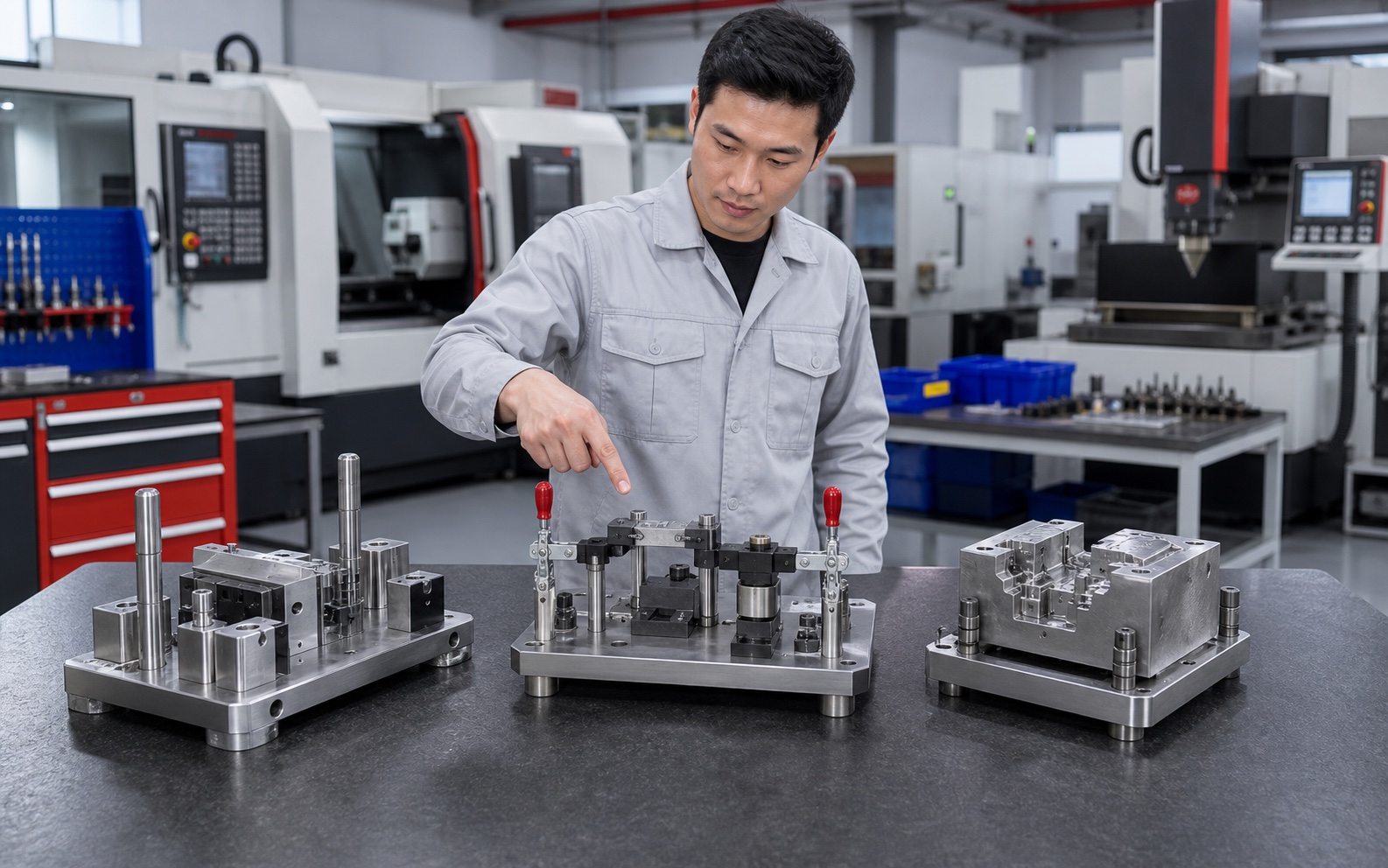
Jigs, fixtures and molds all improve production stability, but they solve different problems in locating, holding, inspecting and forming parts.
1. Jigs position and guide the workpiece
A jig helps place a part in the correct position during machining, assembly or inspection. Good jig design reduces operator variation, shortens setup time and improves repeatability across shifts.
2. Fixtures focus on repeatable holding and inspection
Fixtures are often used for inspection, assembly, pressing, holding and repeated positioning. In connector production, fixtures may hold terminals, housings or small assemblies while dimensions and positions are checked.
3. Molds form or define product geometry
A mold directly participates in forming or shaping a part. Mold inserts usually require stronger material, heat treatment, surface control and higher accuracy depending on production volume.
4. Choosing the right tooling path
If the goal is holding, locating or checking, start with a fixture. If the goal is forming a repeatable product shape, evaluate a mold. For new products, engineering should map each station and decide where jig, fixture or mold tooling is required.