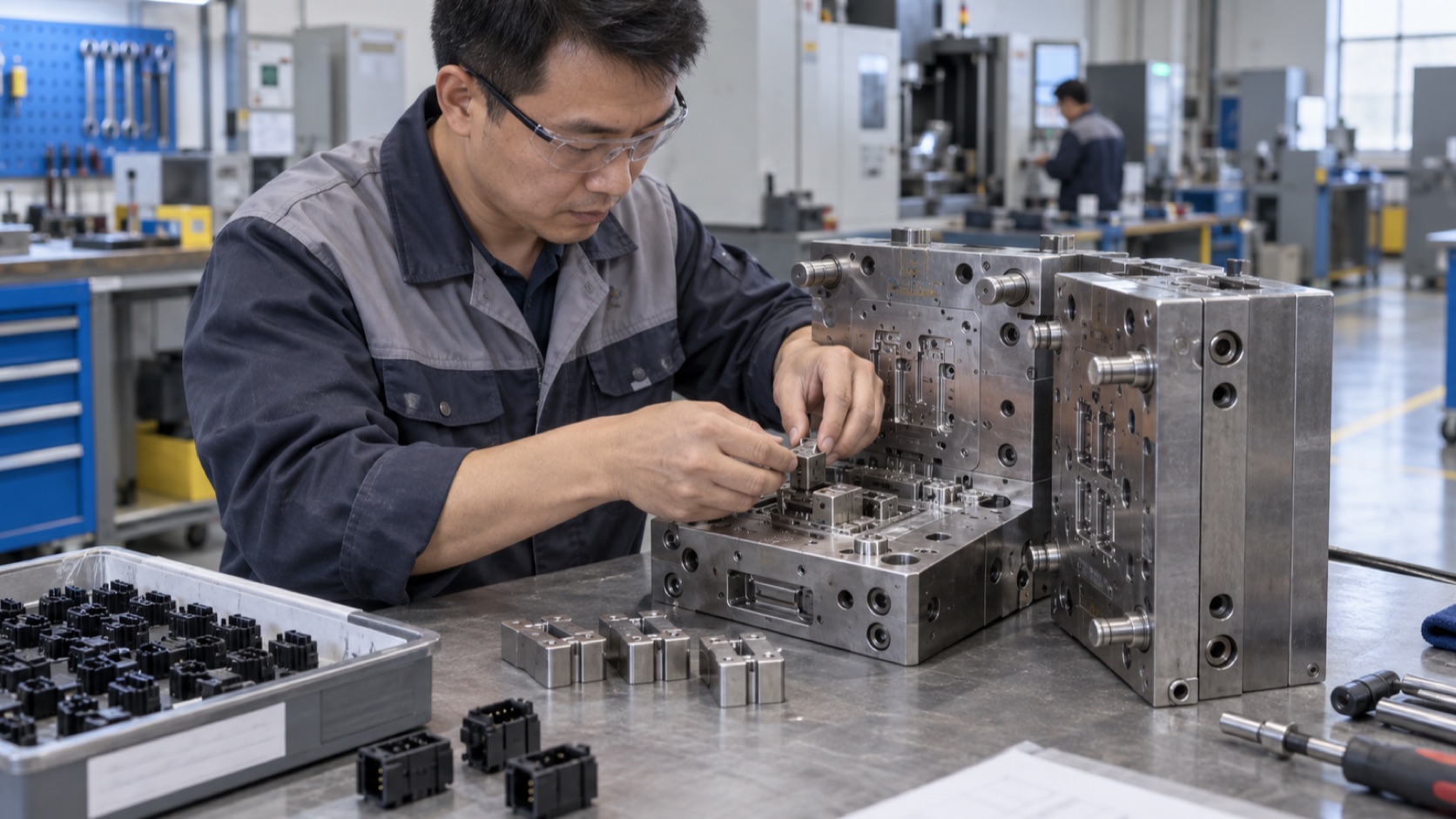
A connector team often needs molded parts in the specified resin before the production tool is justified. The useful question is not whether a rapid mold is universally cheaper, but which functions must be production-representative and which actions can remain manual for the validation quantity.
Define what the molded parts must prove
State the target quantity, resin and glass content, sealing and mating tests, cosmetic zones, critical dimensions and expected design revisions. A stock mold base and pre-hardened inserts can shorten preparation, but the gate, venting, cooling and cavity steel still need to reproduce the features being validated.
Use hand-load inserts only where manual work is acceptable
A removable insert can replace an expensive slide or lifter for an undercut during a short run. It needs positive orientation, safe handling, enough bearing area, controlled shutoff and a repeatable loading check. Cycle time will be longer, so compare the saved tooling work with the planned shot count and operator load.
Plan inspection and the route to production
Approve the mold with first-off dimensional data, material certificates and functional assembly results. Record insert identification, wear points and the molding window. If the design freezes, decide whether the insert concept transfers to a production slide, remains as a serviceable spare, or is replaced by a new production core.