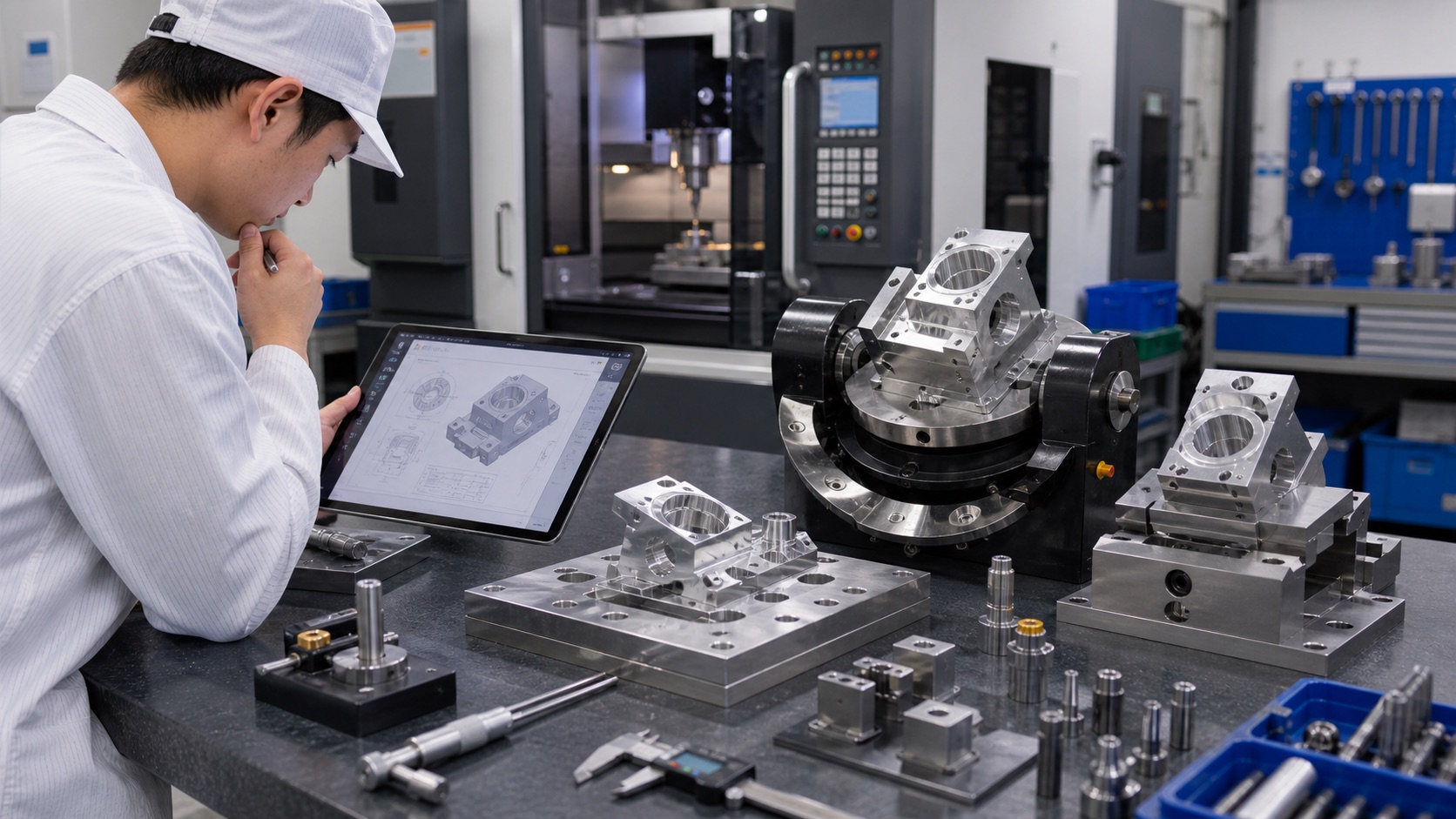
Not every complex part needs 5-axis machining. The right choice between 3-axis, 4-axis, 5-axis and dedicated fixtures balances cost, accuracy, delivery time and assembly risk.
3-axis remains economical for many parts
Plates, brackets, covers, blocks and many automation parts can be machined well on 3-axis machines when datums are clear and the number of flips is limited. It is cost-effective, familiar and easy to inspect.
4-axis helps when geometry rotates around a datum
When holes or faces relate to a central axis, or when repeated unclamping should be avoided, 4-axis machining can preserve geometry better. It still requires a suitable fixture and tool sequence.
5-axis is useful for access and high alignment demands
5-axis machining helps with angled holes, complex surfaces, fewer setups and hard-to-reach areas. But using 5-axis to compensate for unclear datums or poor fixture planning can raise cost without solving the root problem.
Functional drawings lead to better process decisions
Mark datum faces, assembly-related holes, truly critical tolerances and cosmetic surfaces. When the supplier understands function, it can recommend 3-axis with fixture, 4-axis or 5-axis more accurately.