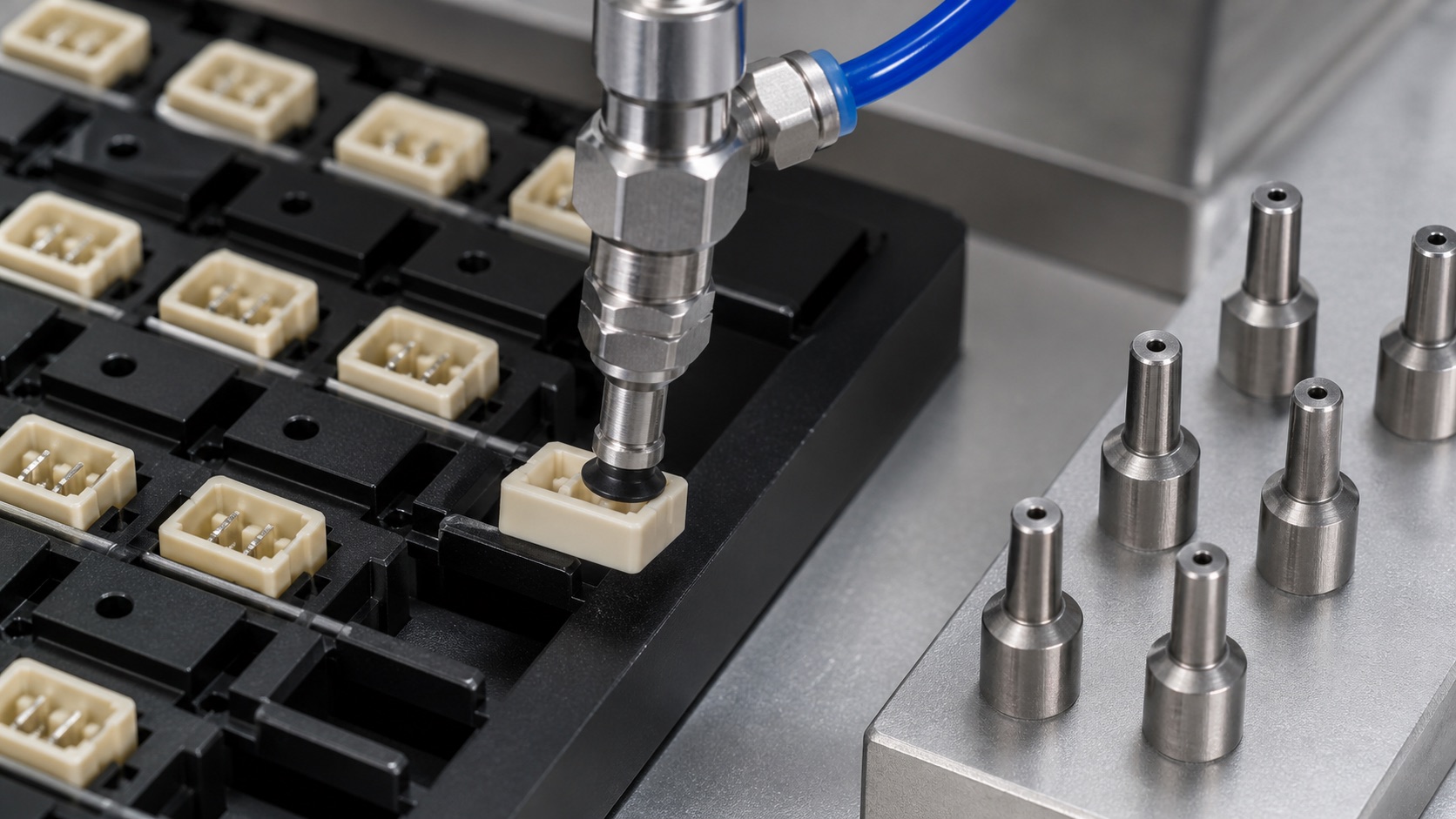
When a connector lifts successfully but falls during transfer, increasing vacuum is not automatically the answer. The contact face, air passage, part position and motion profile need to be checked as one pickup system.
Choose a contact face that can seal
A molded shell may have ribs, ejector marks or openings exactly where the nozzle lands. Mark the usable contact area on the part model and examine samples at the smallest and largest expected dimensions. The theoretical static holding force depends on pressure difference and effective sealed area; catalog vacuum pressure alone does not describe the grip. Trial the actual surface condition.
Separate a sealing problem from an air-path problem
After isolating the machine safely, check the tip, internal bore, hose joints and filter for damage or obstruction. A cracked lip leaks; a blocked bore can delay evacuation and may leave a misleading vacuum reading upstream. Compare empty-tip, correctly loaded and deliberately mis-seated states under an approved test procedure. Confirm sensing location rather than replacing tips blindly.
Check the complete pick-and-release cycle
Test lift, acceleration, rotation and release with representative parts. Record vacuum build-up time, loss during motion, placement repeatability and marks on the shell. A vacuum switch does not by itself prove correct orientation or single-part pickup. Use suitable part-presence or vision checks where required. Changes to interlocks or motion settings belong to the machine integrator.
Specify replaceable nozzle tips clearly
Send the mating thread or shank drawing, tip envelope, bore size, contact geometry, material restrictions and cycle target. State whether silicone-free contact or verified ESD properties are required; black plastic alone does not establish ESD performance. Vietlink Precision can review custom nozzle bodies and tips against the drawing. Request a sample fit and pickup trial before releasing a complete spare set.