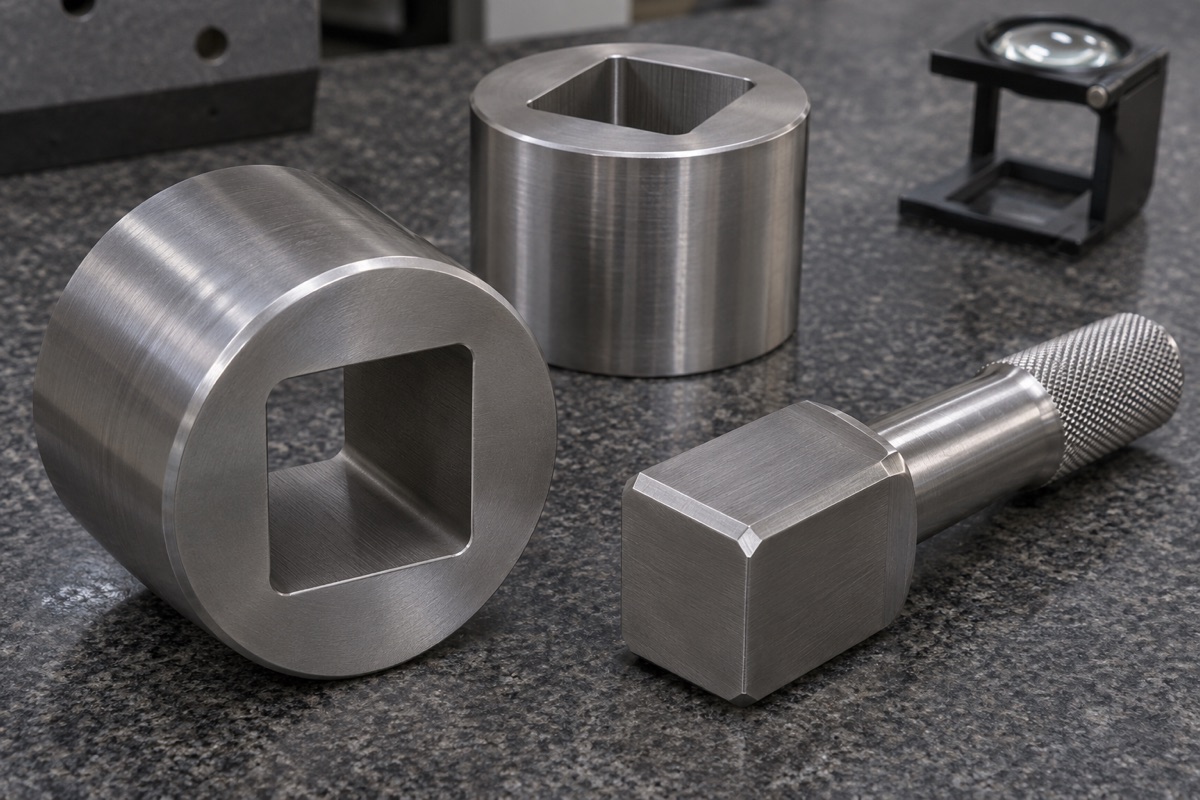
A square bore looks simple until the mating drive catches at the corners or seats with too little flank engagement. Wire EDM can produce a through-profile in conductive material, but not a truly zero-radius internal corner. Define the interface before selecting material and a load-validation plan.
Draw the actual mating section, not just across-flats
Include the male drive dimensions, corner chamfers or radii, entry chamfer, stop shoulder and usable engagement. A nominal inch-drive size does not describe every retention or seating detail. Insertion depth that includes a relieved cavity is not all load-bearing contact. Mark the flank length intended to transmit torque and provide the mating-component drawing or an approved reference part.
Decide whether the bore is through or blind
Conventional wire EDM needs a route for the wire through a conductive workpiece. A closed-bottom socket requires separate consideration of sinker EDM, broaching or another process. Wire size and spark gap limit the inside corner. Do not specify an ideal CAD corner as a guaranteed sharp feature or add enlarged corner reliefs without approval of their effect on strength.
Agree material condition and profile inspection together
Working torque, direction, cycles, wall thickness and transitions govern the strength requirement; 'hard steel' is not a specification. Define heat treatment, final machining, hardness range and surface condition. Measure across-flats at multiple depths and inspect wall form, corners and datum relationships. A qualified mating part can supplement those measurements, but a successful insertion does not replace a dimensional record.
Separate fit, loading and measurement-chain checks
Unloaded assembly establishes only part of acceptance. Load validation needs an approved procedure and guarded equipment. If an adapter changes a torque tool's effective lever arm, follow its instructions for correction or verification; axial extensions and offset adapters are not equivalent. Send Vietlink Precision the interface drawing, duty conditions, material state, quantity and inspection plan. Appearance cannot establish a torque rating.